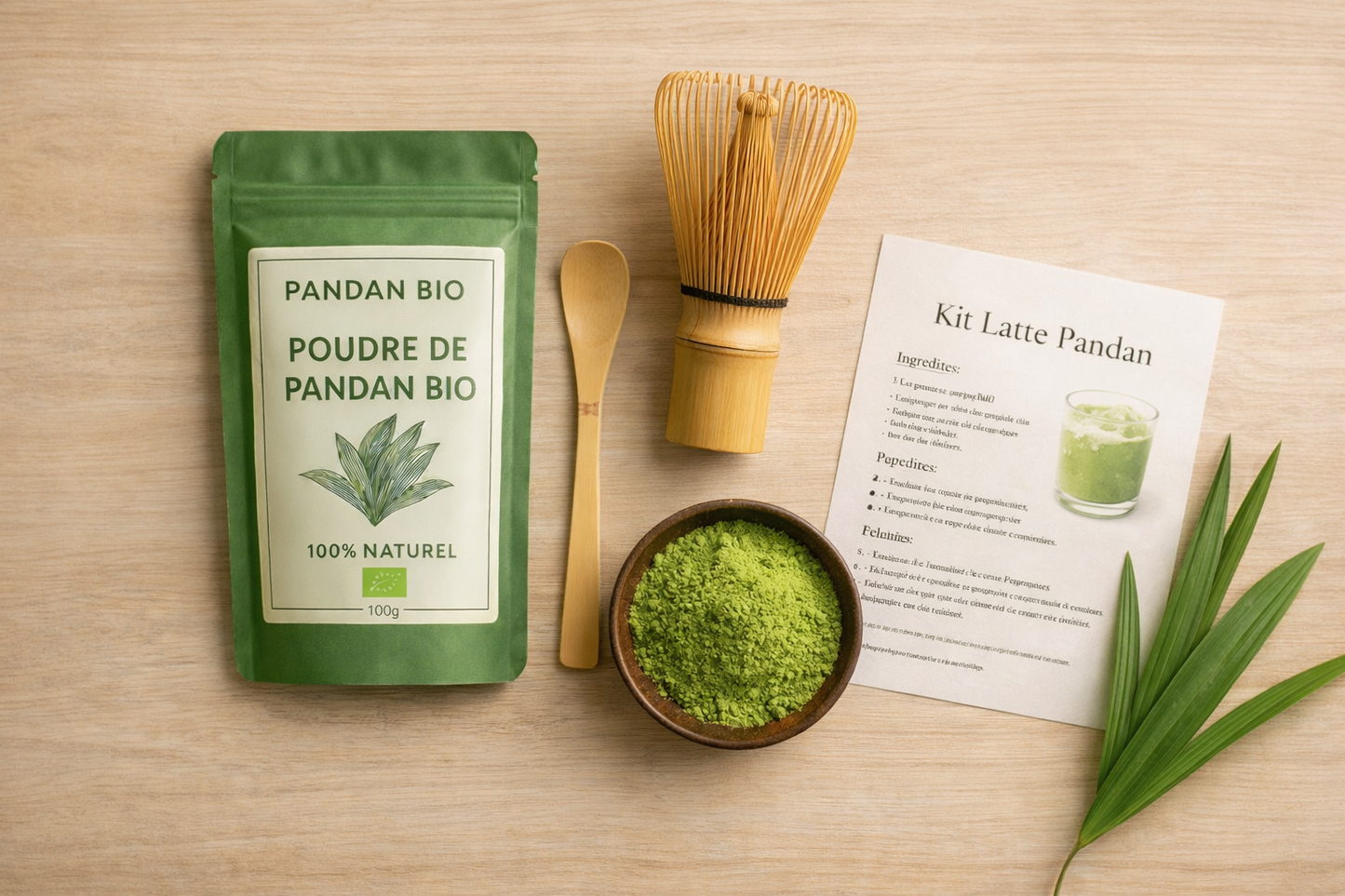
Why does your pandan have no taste? Causes and solutions
Pandan is appreciated for its sweet and distinctive aroma, often described as a blend of vanilla, almond, and coconut. Yet, many people experience disappointment when tasting it: their pandan seems bland, even completely tasteless.
This lack of flavor is generally not due to the pandan itself, but to several specific factors. Origin, processing, product quality, or method of use can strongly influence the aromatic intensity.
Insufficient pandan quality
The most common cause of tasteless pandan is insufficient product quality. Some powders sold as pandan contain very few actual leaves, or even only artificial flavors or green dyes.
A natural pandan powder should be made exclusively from pandan leaves. Its aroma is subtle but distinctly present. Conversely, a powder that is too dull, with no perceptible odor when dry, is often a sign of excessive processing or a diluted product.
Origin and processing method
The aromatic intensity of pandan depends heavily on its origin and drying method. Fresh pandan leaves are naturally very fragrant, but poorly controlled processing can degrade the aromatic compounds.
Drying at too high a temperature or aggressive industrial grinding can alter the aroma. Higher quality powders favor gentle processes, preserving the natural fragrance of the leaves.
Incorrect pandan dosage
Pandan has a delicate taste. Used in too small a quantity, its aroma can go unnoticed, especially in rich preparations like milky drinks or desserts.
Conversely, slightly increasing the dosage often allows its aromatic notes to fully reveal themselves, without ever causing bitterness. Pandan does not express itself as a powerful spice, but as a subtle fragrance that requires a delicate balance.
Unsuitable preparation
How pandan is incorporated plays a key role. A powder simply sprinkled without prior dissolution can lose much of its aromatic potential.
In hot beverages or milk-based preparations, good dispersion of pandan allows for a more homogeneous release of aromas. Too rapid an infusion or an unsuitable temperature can also limit aromatic extraction.
Storage issues
Pandan is sensitive to air, light, and humidity. A poorly stored powder can quickly lose its fragrance, even if its initial quality was good.
Storing it in an airtight container, away from heat and light, helps preserve the aroma longer. Pandan powder that has been open for several months and exposed to air will often be less expressive.
How to restore pandan's flavor?
To fully restore pandan's flavor, it is essential to choose a natural powder, made only from the leaves, without additives. Adjusting the dosage, improving dispersion in preparations, and ensuring proper storage are simple yet effective levers.
In some cases, comparing two powders from different sources can help to better understand the impact of quality on the final aroma.
Conclusion
Tasteless pandan is rarely an inevitability. In most cases, the problem comes from the quality of the product, its processing, or its use. By adopting a more attentive approach to selection, dosage, and preparation, pandan fully reveals its delicate and characteristic fragrance.
Pandan is not an aggressive flavor, but a subtle aromatic ingredient that requires quality raw material to express itself correctly.