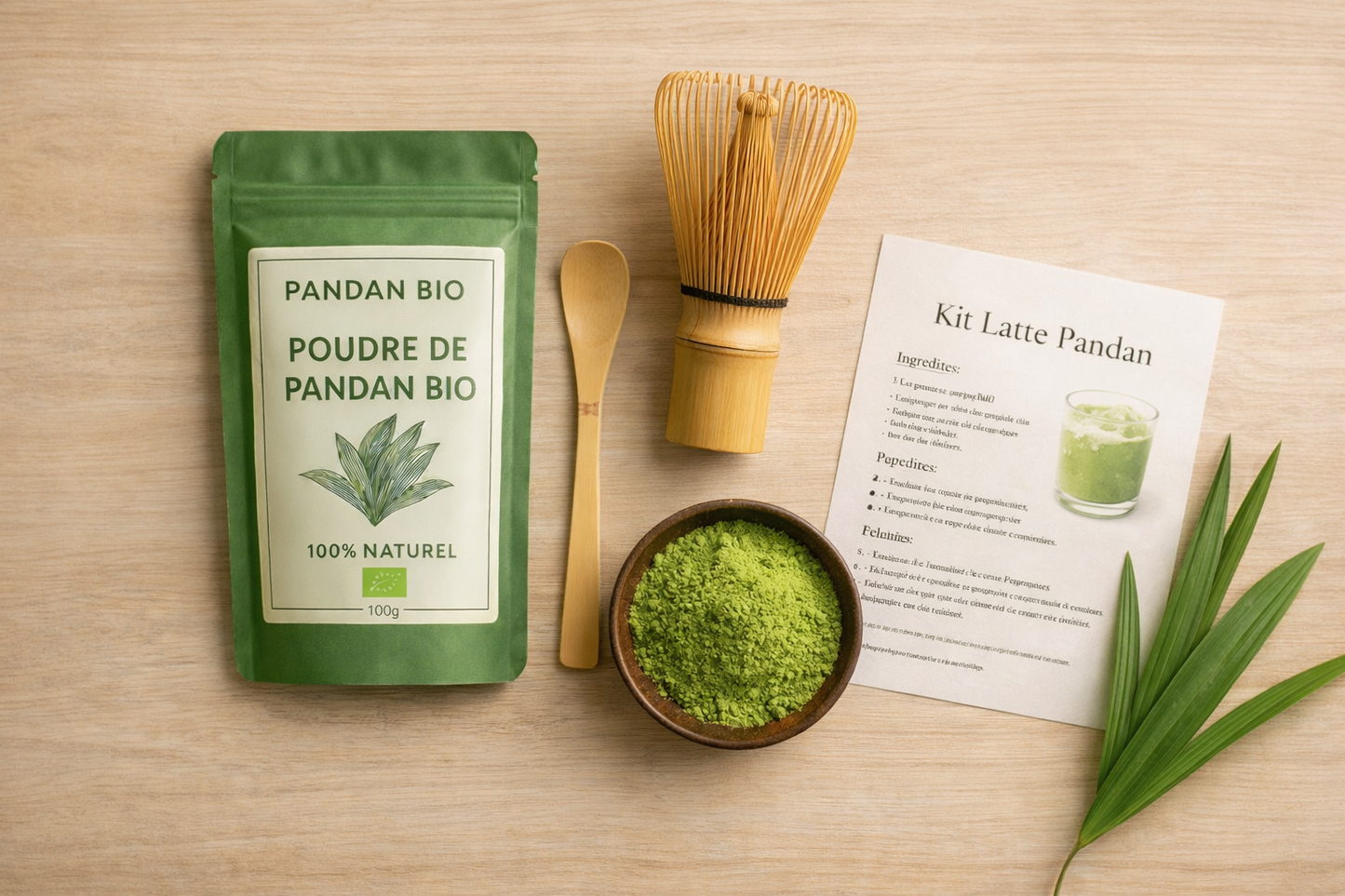
Pandan and health: what does science really say?
Pandan is an aromatic plant widely used in Southeast Asia, both in cooking and as an infusion. In Europe, it is often presented as a natural ingredient associated with well-being, digestion, or relaxation. But beyond traditional uses, what do we really know about pandan's health effects from a scientific perspective?
This article offers a factual and nuanced analysis of available data on pandan, distinguishing between research-based knowledge, empirical uses, and the current limitations of studies.
Composition of Pandan and Studied Compounds
Pandan leaves contain several natural compounds that have attracted researchers' interest. These include chlorophyll pigments, flavonoids, and various phenolic compounds. These substances are also present in many aromatic plants and are generally associated with antioxidant properties.
Some laboratory analyses have shown antioxidant activity in pandan leaf extracts, mainly observed in vitro. These results suggest interesting potential but do not, on their own, allow for a conclusion about a direct benefit in humans.
Pandan and Antioxidant Properties
Antioxidants are compounds capable of neutralizing certain free radicals. Several preliminary studies have shown that pandan possesses measurable antioxidant activity in the laboratory. This property is mainly attributed to the presence of flavonoids and polyphenols.
However, it is important to note that these results primarily concern in vitro tests or animal models. To date, clinical data evaluating a direct antioxidant effect of pandan in humans remain limited.
Pandan, Digestion, and Traditional Uses
In traditional Southeast Asian medicine, pandan is sometimes used for its perceived effects on digestive comfort. The leaves are infused or incorporated into food, particularly in rice or coconut milk dishes.
These uses are primarily based on empirical observations passed down culturally. From a scientific perspective, few clinical studies have rigorously evaluated the impact of pandan on human digestion.
Pandan and Relaxing Effect: Myth or Reality?
Pandan is sometimes associated with a feeling of relaxation, especially when consumed as a hot infusion. This perception could be linked to its caffeine-free nature, its mild aroma, and a soothing sensory effect.
To date, no precise biological mechanism has been formally identified to explain a direct relaxing effect of pandan. It is therefore more accurate to speak of user comfort rather than a demonstrated physiological effect.
Current Limitations of Scientific Studies
Despite growing interest in aromatic plants, pandan remains relatively understudied compared to other ingredients like green tea or turmeric. The majority of available publications focus on chemical analyses or experimental models.
The lack of large-scale clinical trials means that the effects of pandan on human health cannot be stated with certainty. This does not question its food safety but calls for avoiding any overinterpretation of its benefits.
Pandan and Health: What Can We Reasonably Conclude?
Based on current data, pandan can be considered a natural, caffeine-free aromatic ingredient, generally well-tolerated when consumed as part of a normal diet. It offers definite gustatory and sensory appeal, as well as antioxidant potential observed in the laboratory.
However, it should not be perceived as a therapeutic product or a health supplement with proven effects. Its interest lies primarily in its culinary use and its mild profile, rather than in demonstrated medical benefits.
Conclusion
Pandan attracts moderate but real scientific interest, mainly due to its plant compound composition and its antioxidant properties observed in the laboratory. Traditional uses suggest effects on digestive comfort and relaxation, but clinical evidence remains limited.
Consumed in moderation and as part of quality products, pandan can easily be integrated into a varied diet. An informed and nuanced approach allows one to appreciate its qualities without falling for excessive promises.